Searching for a dental receptionist course usually means one of two things: you are new to the front desk and want to get good at it quickly, or you have been doing the job for years and would like your skills to be recognised. Either way, this guide to CPD for dental receptionists and practice managers will help you choose and plan your learning. It covers what is worth learning, what the rules do and do not say about your role, how to fit learning into a day of constant interruptions, and how to keep a record that shows how far you have come.
CPD is not just for clinicians
Most dental CPD is written with the surgery in mind, and it is easy to come away thinking professional development belongs to the people in scrubs. It does not. The front desk is where patients form their first impression of the practice, where anxious callers are calmed down, where complaints are first heard and where appointment books are rescued from chaos. Practice managers carry staffing, rotas, records, inspections and, quite often, everyone else's training as well.
That is skilled work, and skills grow with learning. CPD for dental receptionists and practice managers is simply a planned way of doing that learning and keeping proof of it.
What the rules say about your role
The GDC's Enhanced CPD scheme sets CPD hours for its registrant titles: dentists, dental nurses, dental hygienists and therapists, orthodontic therapists, clinical dental technicians and dental technicians. Receptionists and practice managers are not a registered title, so the GDC's hours targets and annual CPD statement, which are set for those titles, do not apply to you in that role. The exception is anyone who also holds a registered title, such as a dental nurse who has moved into management: if that is you, the GDC's scheme still applies to your registration, so check its page for the detail.
Practices themselves are regulated differently in each nation. In England, the regulator is the Care Quality Commission (CQC). In Scotland, Healthcare Improvement Scotland regulates independent healthcare, including independent dental clinics. In Wales, Healthcare Inspectorate Wales inspects private dental practices, and in Northern Ireland private dental practices register with RQIA, the Regulation and Quality Improvement Authority. Your practice will know which applies and what its inspectors look for.
You will often hear about "mandatory training" for the whole team. Be a little cautious with that phrase: treat the topics usually listed as typical training for a dental team, and check your practice's own policies for what it requires of you. One has a clear published basis: the Resuscitation Council UK's primary dental care standards say that dental staff's knowledge and skills in resuscitation should be updated at least annually, and that new members of dental staff should have resuscitation training as part of their induction.
What a good dental receptionist course covers
The best learning for the front desk is practical: things you can use on Monday morning. When you look at any dental receptionist course or short training, check whether it covers the areas below.
Patients and communication
- Phone and front-desk skills. Greeting, booking, rebooking and handling a full diary without sounding rushed.
- Anxious and nervous patients. What to say, what not to say, and when to hand over to a clinician.
- Complaints handling. Listening, acknowledging, recording and passing a complaint on correctly. Complaints handling is also one of the topics the GDC recommends for registrants, so you will be learning alongside your clinical colleagues.
- Dental terminology. Enough understanding of common treatments to explain appointments clearly, while leaving clinical advice to clinicians.
Safety, safeguarding and the law
- Safeguarding. Reception often notices things first: a missed appointment pattern, a worrying comment, an adult who seems under pressure. Our guide to safeguarding in the dental practice walks through notice, respond, record and refer.
- Medical emergencies and resuscitation. Every member of the team should know what to do and who to call.
- Data protection and confidentiality. Patient records, phone calls in a busy waiting room, and what to do when someone asks for information they should not have.
- Infection control awareness. What the clinical team does and why it matters at the front desk too.
The GDC's list of recommended CPD topics is written for registrants, but it is a useful map of what the whole team talks about: legal and ethical issues, complaints handling, safeguarding children and young people, and safeguarding vulnerable adults all touch the front desk.
CPD for practice managers
Practice managers need everything above plus a second layer: running the business side of the practice. Useful areas include:
- Leadership and people management. Recruitment, induction, appraisals, difficult conversations and keeping a team pulling in the same direction.
- Inspection readiness. Understanding what your regulator expects, whether that is CQC in England or, for private and independent practices, the relevant body in Scotland, Wales or Northern Ireland, and keeping the evidence tidy all year rather than in a panic the week before.
- Policies, records and data. Keeping practice policies current and records secure.
- Finance and operations. Stock, suppliers, labs, the appointment book and the many small leaks that add up.
For a professional association for your role, see the Association of Dental Administrators and Managers, which trades as ADAM Aspire.
Fitting learning into a day of interruptions
The honest problem with front-desk CPD is time. The phone rings, a patient arrives, a clinician needs the diary changed, and the course you started on your lunch break is forgotten by teatime. Long, uninterrupted study blocks rarely exist in reception. Short ones do.
- Learn in short pieces you can pause. A course of about 15 minutes survives the phone ringing; a two-hour webinar usually does not.
- Book it like an appointment. "Tuesday, 8.30, before the doors open" beats "when it is quiet", because it is never quiet.
- Pick the next topic in advance. Decide on Monday what you will learn this week, so a spare ten minutes goes on learning rather than on browsing.
- Learn as a team. A practice manager who shares one useful course in the team meeting gives everyone a starting point and a reason to talk about it.
Make your learning visible
Recognition is easier when there is evidence. A short, simple record of what you learned is useful for appraisals, for conversations about a pay review or a new role, and for showing the practice that you take your development seriously.
Three habits help:
- A plan. A personal development plan (PDP) lists what you want to get better at this year and why. Our dental PDP template works for the whole team, not only clinicians.
- A record. Keep every certificate in one place, recorded on the day you earn it.
- A reflection. A few sentences on what you learned and what you will do differently. If you like a structure, our guide to CPD reflection with the Gibbs Reflective Cycle shows how.
How Enhanced CPD Pro helps the non-clinical team
Non-clinical staff get access to everything in Enhanced CPD Pro that GDC registrants do. For a receptionist or practice manager, that means:
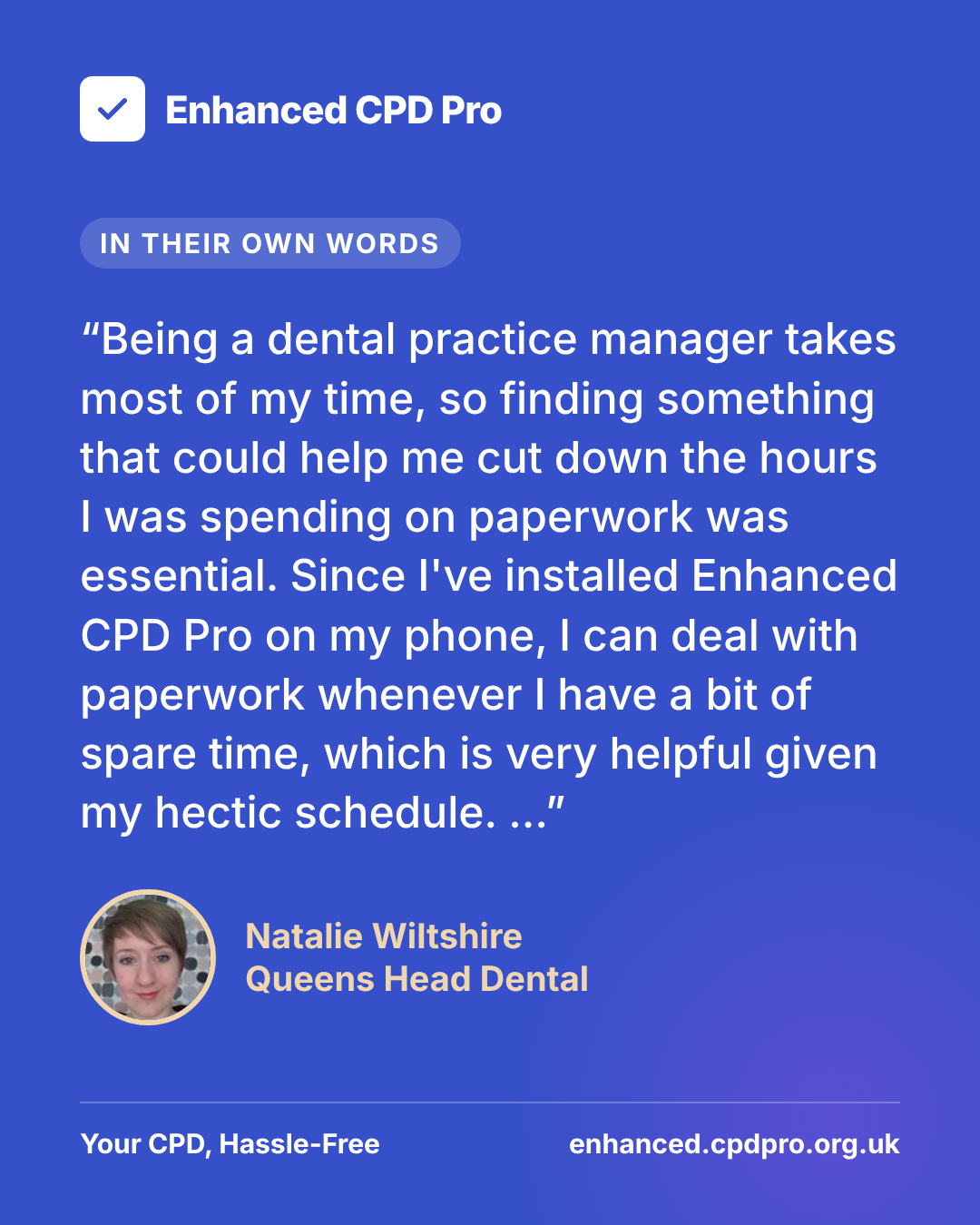
- SkillBytes: free micro-courses of about 15 minutes. You earn a certificate each time and collect it in the app. Short enough to survive a busy front desk.
- A course library of full-length courses, included in the free trial and subscription, and every course has its own AI you can question for deeper insight. No dental degree required to ask "what does that actually mean?"
- Deep Learning: name a subject, such as complaints handling or data protection, and the app builds a deep-dive course on it from published papers and other reputable sources.
- An AI-assisted PDP that tracks your goals and the courses that progress them, with a usable draft PDP created during onboarding in 60 seconds.
- Certificate scanning: upload, photograph or email a certificate and the app creates a detailed CPD record. CPD importers bring in records held in other web services, so everything is in one place.
- An AI-assisted CV builder that keeps your CV up to date as your career moves on, whether that is towards senior receptionist or practice manager.
The app works on all devices, so your learning and your record are on your phone whenever a quiet ten minutes turns up.
Frequently asked questions
Do dental receptionists have to do CPD?
Dental receptionists are not one of the GDC's registrant titles, so the GDC's CPD hours and annual statement do not apply to the receptionist role itself. Your practice may set its own training expectations, and the Resuscitation Council UK's primary dental care standards say dental staff should update their resuscitation knowledge and skills at least annually.
What should a dental receptionist course cover?
Look for practical skills you can use straight away: phone and front-desk communication, anxious patients, complaints handling, safeguarding, medical emergencies, data protection and enough dental terminology to explain appointments clearly.
Does CQC apply to every dental practice in the UK?
No. CQC regulates health and adult social care in England. Scotland, Wales and Northern Ireland have their own arrangements, including Healthcare Improvement Scotland for independent healthcare, and Healthcare Inspectorate Wales and RQIA for private dental practices.
I am a dental nurse who now manages the practice. Do the GDC rules still apply to me?
If you still hold a GDC registered title, the GDC's CPD requirements apply to that registration. The GDC's CPD scheme page sets out the hours for each title.
Your development counts too
A good dental receptionist course, or a steady habit of short learning, does more than tick a box. It makes the front desk calmer, the practice smoother and your own career easier to grow. Pick the skills that matter most to your role, learn them in short pieces, and keep a record that shows what you have achieved.
Sources
- General Dental Council, CPD scheme
- General Dental Council, Recommended CPD topics
- Care Quality Commission, About us
- Healthcare Improvement Scotland, Home page
- Healthcare Inspectorate Wales, Private dental practices
- Regulation and Quality Improvement Authority, Home page
- Resuscitation Council UK, Quality standards: primary dental care
- Association of Dental Administrators and Managers, ADAM Aspire